
The term “clean label” generally refers to products made with a simplified list of natural, familiar, and minimally processed ingredients and without artificial additives, synthetic preservatives, or chemical-sounding names.
These additives serve critical roles in meat processing: nitrite inhibits microbial growth and promotes the formation of nitrosyl hemochrome, a heat-stable pigment responsible for the characteristic pink color of cured meat; ascorbate converts nitrite to nitric oxide and prevents lipid oxidation; and phosphate enhances water-holding capacity (WHC), textural integrity, and emulsion stability.
Nitrite Replacement Strategies
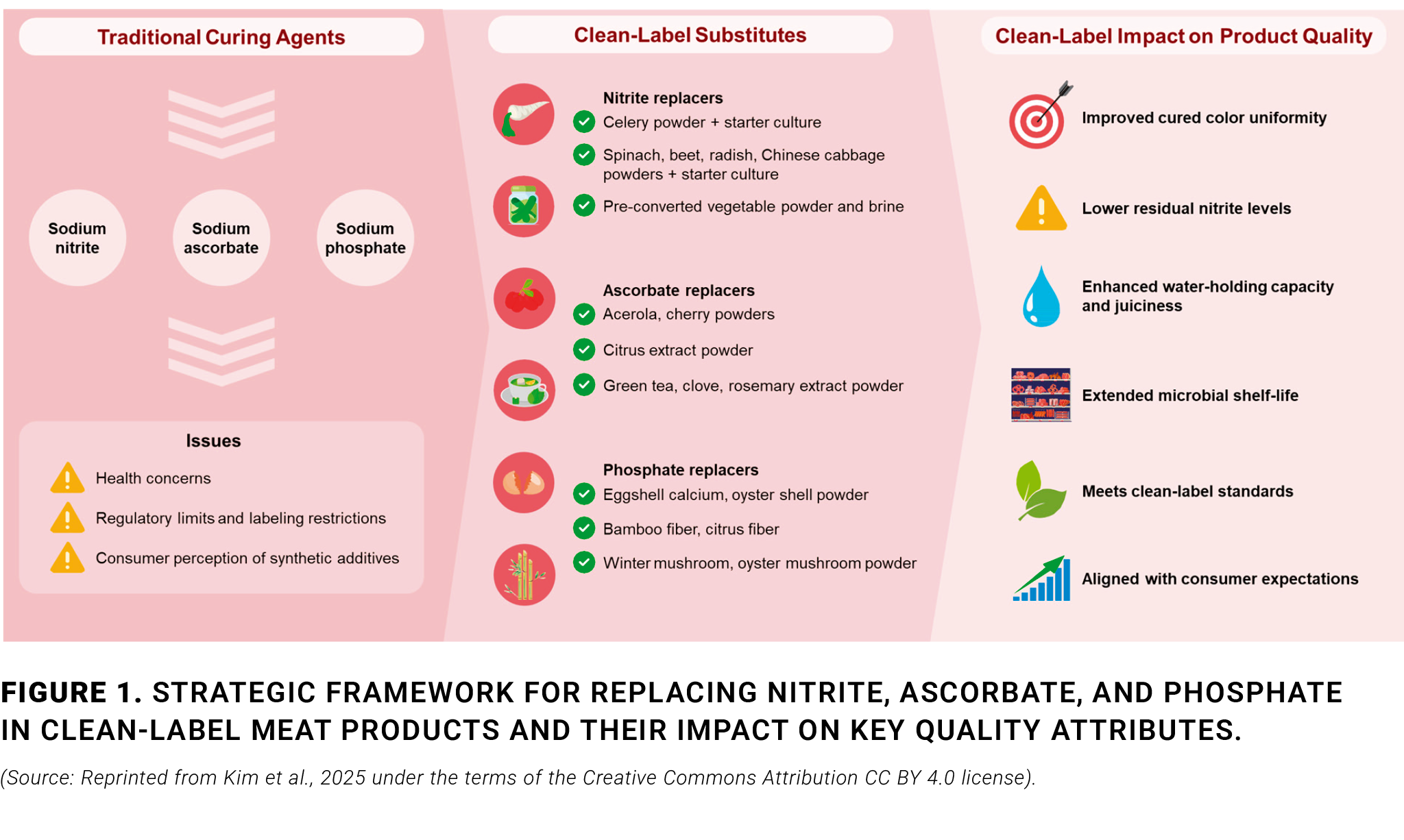
For nitrite replacement, nitrate-rich vegetables such as celery, beetroot, and radish, which are often combined with nitrate-reducing starter cultures or used in fermented, pre-converted forms, have shown potential as indirect sources of nitrite.
A primary clean-label curing strategy involves replacing synthetic nitrites with nitrate-rich vegetables, particularly celery powder, which is the most widely used in commercial meat production. Other vegetables, such as spinach, radish, beetroot, and Chinese cabbage, have also demonstrated nitrate levels and curing efficacy comparable to those of celery.
These vegetables are typically applied in their powder or extract form and contain high levels of naturally occurring nitrate, which can be microbially reduced to nitrite during processing. When combined with nitrate-reducing bacteria such as Staphylococcus carnosus under controlled pH, temperature, and salt conditions, this in situ conversion effectively reproduces traditional curing processes and is suitable for both cooked and dry-cured meat products.
Starter cultures are employed owing to their high nitrate reductase activity, which promotes the in situ reduction of nitrate to nitrite and facilitates nitric oxide generation. Starter cultures such as S. carnosus and Staphylococcus xylosus are frequently employed owing to their robust nitrate reductase activity and tolerance to salt and curing conditions.
Unlike in situ systems, pre-converted powders are generated through controlled fermentation processes, yielding stable nitrite concentrations suitable for direct incorporation. In contrast to microbial nitrate conversion, pre-converted vegetable nitrite systems provide a direct and standardized source of natural nitrite without relying on in situ microbial activity. These systems are typically applied as dried powders or liquid brines and are particularly suitable for heat-treated or emulsified meat products, where microbial viability is limited.
However, fluctuating nitrate levels caused by both genetic and environmental factors can result in unpredictable residual nitrite concentrations, thereby complicating product standardization, safety assurance, and regulatory compliance.
Curing Accelerator & Antioxidant Replacements
Similarly, natural curing accelerators, including vitamin C-rich ingredients (e.g., acerola and citrus peel) and polyphenol-rich antioxidants (e.g., rosemary and green tea), have emerged as viable alternatives to synthetic ascorbate owing to their reducing and antioxidative properties.
Acidulants, including lactic, citric, and acetic acids, enhance nitric oxide generation by lowering the pH, thereby accelerating the curing reaction and improving microbial stability. Conversely, reductants such as ascorbate and erythorbate function as electron donors, directly reducing nitrite while simultaneously providing antioxidative protection.
Acerola is one of the most frequently studied natural sources of vitamin C for meat curing.
Among polyphenol sources, tea-derived catechins and theaflavins have shown notable promise. The inclusion of tea polyphenols (300 mg/kg) in pork sausages containing 150 mg/kg sodium nitrite significantly increased redness and nitrosyl hemochrome formation while reducing metmyoglobin and residual nitrite content.
Green tea polyphenols reduced TBARS, residual nitrite, biogenic amines, and N-nitrosodimethylamine while achieving the highest sensory scores. Lyophilized rosemary extract reduced TBARS by up to 47.3% after 49 days, outperforming rosemary essential oil and synthetic antioxidants.
Pre-converted celery powder and cherry powder developed cured color comparable to nitrite-treated products, reduced residual nitrite levels, and demonstrated high acceptability in both visual appearance and overall sensory attributes.
Phosphate Replacement Strategies
In phosphate-free systems, various functional substitutes, such as hydrocolloids, dietary fibers, protein-based binders, and naturally derived calcium powders, have shown partial effectiveness in restoring WHC, buffering ability, and textural attributes.
Phosphates, on the other hand, play essential roles in adjusting pH, improving protein solubility, and enhancing WHC and emulsion stability, which are crucial functions for maintaining product yield and textural attributes. They are increasingly being replaced by dietary fibers (e.g., citrus and bamboo fibers), protein-based binders (e.g., soy or pea protein), and calcium powders derived from eggshell or seashell sources.
Natural phosphate substitutes have been broadly classified into six functional categories based on their origin and primary mechanisms of action: (1) Hydrocolloid-based binders, (2) Protein-based ingredients, (3) Naturally derived calcium powders, (4) Dietary fibers, (5) Mushroom-derived replacers, and (6) Combination systems.
Natural calcium-based powders, particularly those derived from eggshells and oyster shells, have attracted attention as potential clean-label alternatives to phosphates in processed meat products. Their primary mechanism involves increasing the pH of the meat system, thereby enhancing protein solubility, WHC, and gel strength, which are key functionalities of synthetic phosphates.
Combination systems represent a strategic approach for substituting synthetic phosphates by incorporating multiple clean-label ingredients with complementary functionalities. These systems typically integrate natural calcium powders, proteins, dietary fibers, and hydrocolloids to fulfill the extensive range of technological functions provided by phosphates.
Non-Thermal Technologies
High-pressure processing (HPP), ultrasound (US), and cold plasma (CP) offer unique mechanisms that can improve microbial stability, physicochemical properties, and curing reactions. These approaches are particularly relevant in systems with reduced nitrite, ascorbate, or phosphate.
The mechanistic advantages of US in meat processing are predominantly linked to its ability to extract and reorganize salt-soluble myofibrillar proteins. Such structural modifications enhance protein–water interactions, improve emulsification, and bolster system cohesion, thereby compensating for the absence of phosphate-based emulsifiers and enhancing WHC.
Cold Plasma (CP) technology has emerged as a promising non-thermal intervention for clean-label meat curing, owing to its ability to generate reactive nitrogen species in situ under ambient or mild conditions without direct addition of synthetic nitrite. By producing reactive oxygen and nitrogen species, including nitric oxide, nitrogen dioxide, and ozone, CP initiates curing reactions and facilitates pigment formation.
Economic, Regulatory Challenges & Conclusion
Regulatory interpretations of “clean label” are not harmonized across countries or product categories.
For example, natural nitrite sources such as cultured celery powder could cost 15 to 20 times more than their synthetic counterparts, thereby introducing significant formulation cost burdens in commercial production.
To enable practical application in meat products, future research should aim to integrate ingredient functionality with technological innovation while aligning clean-label development with safety, consumer perception, and sustainability goals.
Source: Adapted and condensed from Kim, M.; Bae, S.M.; Yoo, Y.; Park, J.; Jeong, J.Y. “Clean-Label Strategies for the Replacement of Nitrite, Ascorbate, and Phosphate in Meat Products: A Review.” Foods 2025, 14, 2442. https://doi.org/10.3390/foods14142442. Published under the Creative Commons Attribution (CC BY 4.0) license.